The most important fact about a technology isn’t what it does. It who it does it for, and who it does it to.
I’ve tried my best to take a balanced view of the AI wave. There’s an enormous amount of absolute garbage, it’s accelerating how bad actors behave, and it’s already turned into a crutch for too many of us. But it has wonderful applications as well - it’s helping me build my own AI server to slowly exit the Amazon Echo ecosystem, I’m able to have higher-order conversations and get more work done since I can delegate tedious tasks, and it’s even helped me recover wedding photos from 20 years ago. It’s wonderful, it’s horrible. Because I’m generally on a lean news diet, I wasn’t as aware of the ‘horrible’ part, though.
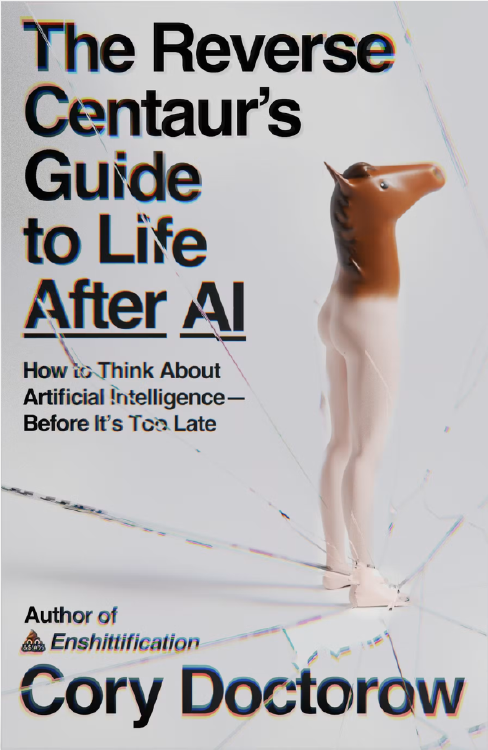
So what is a reverse centuar? It’s the opposite of a centaur! Okay, what’s that? A “centaur” in this case is the idea of a machine-augmented human - the human is in control but their capabilities are aimplified thanks to the strength/speed/knowledge/etc that the machine offers. The human drives the machine.
A reverse centaur is exactly what it sounds like - the machine is driving the human. Have you had to work around a machine because it was rigid and wasn’t helpful? Have you blindly followed the followup questions from an AI chatbot without really asking yourself why? You’re letting the machine drive you. That’s a reverse centaur.
This book isn’t just 200+ pages of classic Cory snark (though there’s plenty of that in there). He starts with the fundamentals, then builds up to some defensible, logical conclusions. Starting with what it means to be a ‘stale’ and a ‘growth’ company. Short version - you know all those AI ads? If you’ve taken a ride in the DC metro near the Pentagon, you may have also seen AI ads aimed directly at the DoD and warfighter. Those ads aren’t for you. They’re for investors. They’re for the twelve congressional staffers that have a direct line to people in Congress. That you and I have to see them is just collatoral damage. That’s because we (generally) know that this is a lot of noise - that the ads are promising, at best, vaporware and, at worst, outright scams meant to simply extract money out of people.
Investors and CEOs are talking to each other. Unfortunately, they’re all using the same radio frequencies that we are so we have to listen to their chatter too, even though 1) It’s not meant for us and 2) we don’t even want to hear it.
From here, we get to revisit (and be reminded of) the coming AI bubble. I’m willing to say that a year ago, I knew we were due for a ‘correction’ but I wasn’t convinced this was a bubble, per se. But after learning about the circular funding, plans for datacenter expansions defying the laws of physics (seriously, where does all that raw material come from?), and seeing even more shell companies and just flat-out worthless companies attracting attention, I am now 100% confident that we are, indeed, in a bubble. Cory does a great job at giving us a little perspective on this. “All bubbles are bad”, he says. However, “some bubbles are productive”. Some simple examples - The dot-com bubble was disastrous but it left behind a lot of capable software developers and gave birth to a whole ecosystem of technologies that created the Internet as we know it today. The Worldcom scandal was a massive fraud bubble and highly damaging. However, it laced the earth with long-lasting fiber, which is used to this day to continue building high speed Internet connections for all of us. The crypto bubble…. is not productive. The only thing it leaves behind is empty wallets and stupid looking drawings of monkeys.
So what will this bubble leave behind? In Cory’s view, a large collection of bargain-priced GPUs, a lot of smart data scientists looking for work, and a modified way of life where we (us, you, me) can run small, finely-tuned models on our laptops and phones. These models are super simple, super smart, and consume remarkably small amounts of energy (as opposed to their ‘frontier’ counterparts, which demand the back-half of the sun in energy). This last note is what was on my mind the whole time I was going through the book though, and it really made me think of The Coming Wave.
Cory’s book is the cynical side of the same coin as The Coming Wave, in my opinion. In the latter, Mustafa explains that high-impact technologies take the form of a ‘wave’. Railroad, steam engines, computing, the Internet, mobile phones, were all waves of technology. These waves follow a pattern that is effectively a buildup, cresting, crashing, and then (and this is the distinction) the technology simply becomes endemic to ordinary life.
Cell phones in the 1980’s were magic. Now you couldn’t pay me to carry a flip phone because my smartphone is so much better. Connecting to the Internet was worth the extra phone line. Now it’s just ubiquitous. This is where we are with AI. We’re in the cresting, and after some time, it will be boring and endemic. It will be just another tool. Personally, I can’t wait for this phase. But where Mustafa has a clean, almost academic explanation, Cory fills the gaps by explaining the human cost of these waves - unemployment, anti-union behavior, outright lying (seriously, the stories about the Tesla bot just being a guy in a suite and the “Just Walk Out” stores being 100% manned by people in India with CCTV cameras are embarassing for all of us), wage theft, surveillance pricing, etc. And that’s all to say nothing of the collatoral damage in the form of 401(k)’s and other retirement nest eggs getting torpedoed when the inevitable pop comes. Retirements are going to be ruined, or at least postponed, by this bubble. Those people did nothing wrong. Their only sin was choosing the wrong time to try to retire.
I love the idea of working as a Centaur. But something I’ve been thinking about is how we’re all realizing that we’ve been thinking about AI the wrong way. A year ago, it was “AI is going to replace all jobs!”. Today though, I’m not so sure. The AI we have right now is an excellent 80% solution. It gets you a good way toward the answer, but you still need a human to finish the job (easy example - a robot could drive a delivery truck but you still need to get out of the truck, deliver the package, obtain a signature, etc). For all the work of engineering that Last Mile of getting a job done, you could just keep the humans involved and A) keep our collective humanity and still B) save the research dollars for something else.
But this bring me back to the realization - we’re not going to actually save money with AI (and I still think it’s artificially cheap today). It’s just going to be another line item in your bill, right alongside cloud costs and air conditioning. The part I haven’t figured out yet, then, is where is that money coming from? Part of me worries that I won’t like that answer but maybe if we look back to the computing/internet/cloud waves that came before, we can find some patterns that will apply here.