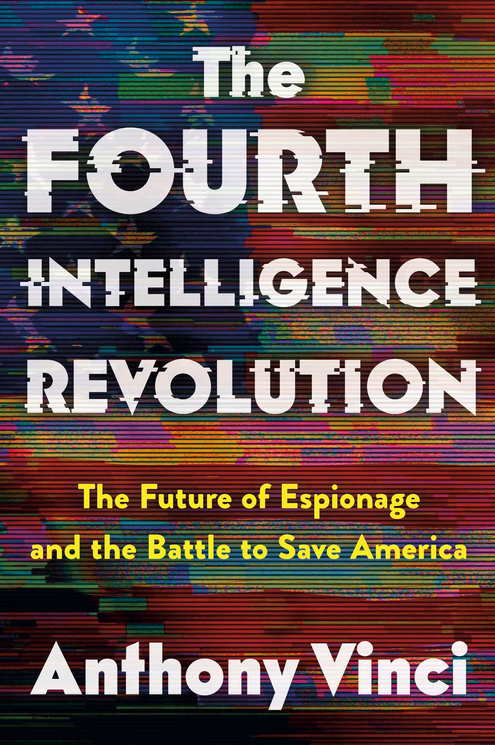
This one surprised me in the window of a bookstore while I was in Savannah. Not surprised me because of where it was found, but more for the fact that it was just sitting in the window, inviting everyone on the sidewalk to glance at the cover. I had to do a double take to be sure I read the title correctly.
I walked in.
Written by a former director of the National Geospatial Agency, The Fourth Intelligence Revolution grounds us in a brief history of the previous three revolutions (World War, the Cold War, and the Global War on Terrorism). Each era solves the current intelligence challenges while laying the groundwork that will become the enabler for the next failure, thus sparking the next ‘revolution’.
The most recent example is the most powerful, in my opinion. The Cold War was built on Need to Know and compartments and hoarding information. During this time period, this approach made sense. There wasn’t an Internet, so information moved slowly and was of a different nature. However, this effectively balkanized the US Intelligence Community, leading to the problem of “having all the pieces but being unable to solve the puzzle”, which is what led to the Intelligence failure of 9/11. What followed this was the ’third’ intelligence revolution and got us through the Global War on Terror (or GWOT) phase.
With each phase, the primary actor that the U.S. was up against has also changed. During the Cold War, it was the USSR. In the GWOT, the insurgency. Now that we’re approaching the fourth revolution, that role is now shifting to China.
So what are the characteristics of this new revolution and what will Intelligence look like going forward? Anthony has a number of suggestions but several stuck out as novel to me. In no particular order, they are…
Economic Espionage
Knowing what a particular country’s economic conditions are is not new but it shines a light on the evergreen problem of balancing ‘safetey’ and ‘freedom’. In short, China has more insight into American companies (as well as its own) than does America. The largest reason for this is that the United States does not spy on its own citizens. We know that this is not 100% true, to be clear. History is littered with U.S. intrusions into privacy. However, that they are blemishes on a tapestry and not the entire fabric is the point. China has built, is building, an enormous surveillance state. Any company conducting business in China (including American companies) must agree to turn over any-and-all data to the CCP, at any time it’s requested. That’s the norm. In America, it’s anathema.
This will be a theme throughout the entire book, compare/contrast of a democratic system with an authoritarian one.
Genetic Espionage
“Data is the new oil” was a phrase thrown around during the growth days of “big data”, when people were building Hadoop clusters and figuring out how to harvest/analyze untold volumes. That statement is quite possibly more true today than it was twenty years ago. And as far as China is concerned, all data is useful data. Consider DNA testing companies that screen you for your ancestry or for your genetic predispositions. Now consider that they are all targets of cyber attackers. Exfilling of this sensitive data is highly useful to an authoritarian nation that is trying to build a global surveillance system (what Anthony calls a global Panopticon). It’s getting a little bit tin-foil hat, but if you entered into a war with a nation, and you had enough information to influence a bioweapon and optimize it for a specific set of people? Or if you were conducting genocidal activities and needed a means to quickly identify, not by paperwork but by DNA analysis, whether or not someone was on the ‘undesireable’ list? And if you could program a machine to identify people by their unique eye biometrics and take action on that information? All with ‘free’ information you didn’t have to gather yourself, but just stole from ‘valid’ owners. Again, these are extreme but, in my experience, ’extreme’ becomes ’normal’ much quicker than we all think.
And of course, data is the primary fuel that powers…
AI
Entire books can be, and have been, written on the implications of AI. But specifically here, Anthony makes the case that AI can augment the work of an intelligence analyst. This aligns with a lot of how I see AI being used in my day-to-day work. That is, the human offloads work onto the machine in the case where the machine simply moves faster. Judgement calls are still up to the human but looking for patterns, cross-referencing related material, and synthesizing information is all done by the machine, thus speeding up the human.
Another point made that I hadn’t even considered was part of the AI models themselves. It’s no secret that some of the ‘best’ AI models are developed in China. Sidestepping the topic of IP theft and model distillation, the reason I avoided running Chinese models in my own home was mostly a paranoia about inviting a spy into home. I was concerned about the model surreptitiously scanning my home network or attempting to exfil data somehow. That may still be the case but something I hadn’t considered was that the model is trained to encourage the viewpoints of the CCP. Take Qwen, or DeepSeek, and ask them their thoughts on the Tieanenman Square Massacre, or what they know about Taiwan. If the result surprises you, consider yourself informed now.
We’re building the future with these AI models. New webapps, new phone apps. Psychotherapists, advisors, all sorts of roles we haven’t even thought of yet. It is very difficult to overstate how important it is that we trust where these models came from, that they’re not subtly encouraging certain behavior or promoting content that favors the CCP. Anthony reminds us of the old Lao Tzu line about winning a war without raising a sword. Deploying technology, getting a population on that technology, and using that technology to curry favor with the population, is the modern execution of this strategy.
Citizen Intelligence
Anthony mentions repeatedly that “we are all intelligence officers now” and I can appreciate where he’s coming from but we don’t live in that world. We should all be at least slightly aware of geopolitical happenings but we all have careers and kids and mortgages and can’t really be bothered with an additional civic duty.
That said, what I did find promising is the idea of a cooperative loop between the Intelligence Community and the general public. Even better, public citizens have access to open source intelligence (or OSINT), which has become immensely more valuable in the last decade. Bellingcat is an online platform for normal, ordinary citizens to collaborate and stitch together information to act as an unofficial, global intelligence unit. When CIA Director Ratcliffe travelled to Moscow, it was flight tracker hobbyists that noticed and broke the news.
There’s a lot of untapped potential here, in my opinion. Obviously it’s a very delicate balance that needs to be struck between “does not infringe on U.S. rights” and “is actually useful” but that can be done.
Wrap Up
If you’re at all interested in geopolitics, AI, or the next chapter of two superpowers navigating the 21st century, consider this book highly recommended. It’s made me a little more paranoid but has also been a thought provoking journey to listen to Anthony’s thoughts on what the next decade can look like for part of the secret ecosystem that’s been operating in plain sight.